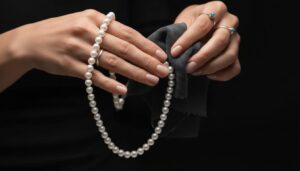
A pearl is the only gem born from a living breath. It’s less of a cold stone and more of a delicate, organic biography that requires a touch far softer than the industrial scrub of a diamond. You likely feel a quiet hesitation when reaching for your favorite strand. It’s natural to feel torn between 1950s household advice involving vinegar and modern detergents that might strip the soul from the nacre. If you’ve ever wondered how do you clean pearls without rotting the silk thread or dulling their glow, you’re not alone.
I’m here to share the artisanal secrets to maintaining that luminous luster through a mindful, 3-step ritual. Since nacre layers often measure less than 0.5 millimeters thick, we’ll move past the confusion of conflicting DIY tips to establish a safe practice for your wearable art. You’ll learn the precise storage methods to prevent yellowing over the next 15 years, ensuring your pieces remain as bold and authentic as the day they were handcrafted. This guide offers the clarity you need to handle these sculptural treasures with the reverence they deserve.
Key Takeaways
- Understand the delicate composition of nacre to appreciate why these organic gifts from the sea require a more soulful, gentle touch than traditional gemstones.
- Master the artisanal “Damp Wipe” method to learn how do you clean pearls safely at home using a simple, non-detergent toolkit.
- Identify the “silent killers” of iridescent luster, including why ultrasonic cleaners and common beauty products should never touch your wearable art.
- Adopt the “Breathable” storage philosophy to protect your jewelry from environmental stress and the abrasive edges of harder metals.
- Reframe your cleaning routine as a ritual of preservation that honors the artist’s original vision and the unique character of handcrafted materials.
The Organic Nature of Pearls: Why Gentle Care is Mandatory
Pearls are a sculptural gift from the sea. Unlike diamonds or sapphires forged under intense geological pressure, pearls are biological wonders grown within the soft tissue of a living mollusk. This origin makes them organic gems. They possess a soul and a history that stone-based jewelry simply cannot replicate. Because they are born of life, they remain sensitive to the world around them long after they leave the water. Understanding this biological connection is the first step in learning how do you clean pearls without compromising their integrity.
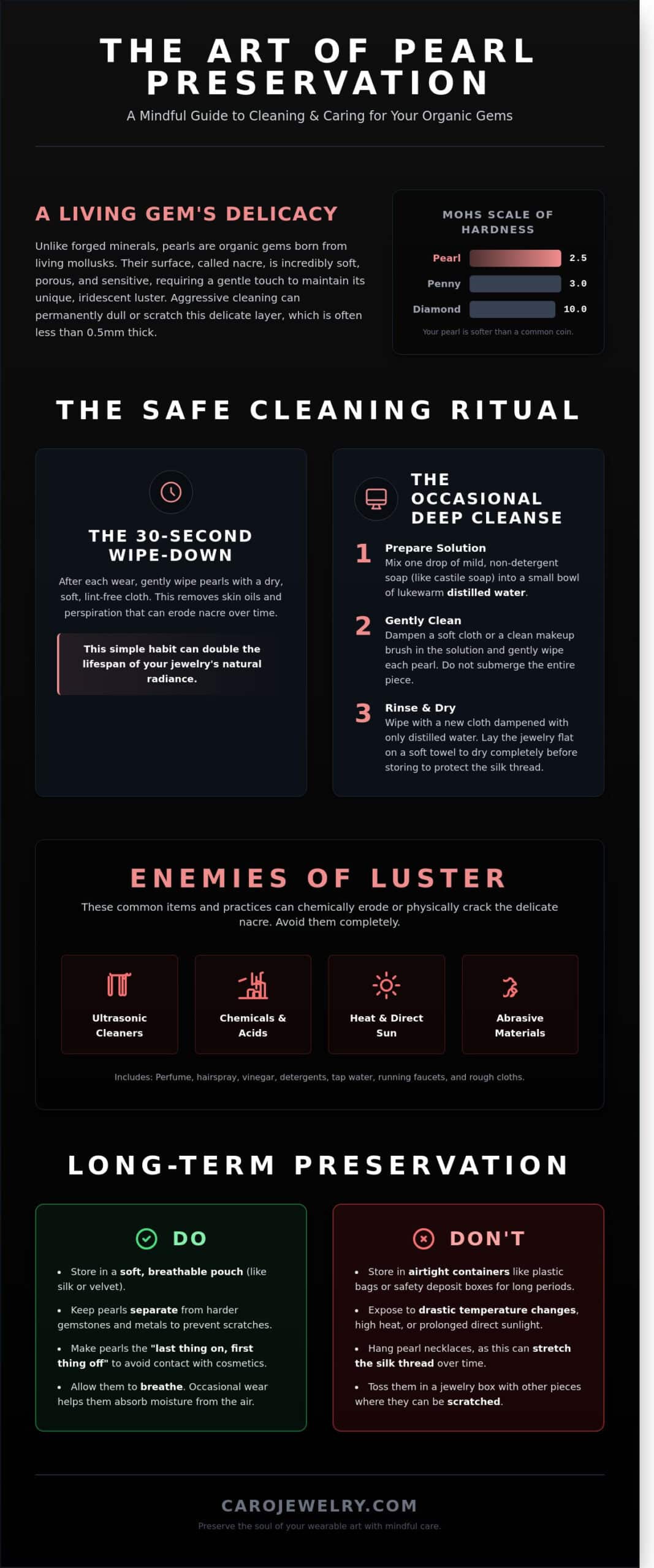
On the Mohs Scale of Mineral Hardness, pearls occupy a precarious position. They rank at a 2.5. To put that into perspective, a common copper penny carries a hardness of about 3.0. Your pearls are literally softer than the coins in your purse. This delicate nature means that dust, which often contains microscopic bits of silica, can actually scratch the surface of a pearl if wiped too aggressively. They are living gems that require a balance of moisture and air. If you lock them away in a dry, airtight safety deposit box for years, they will dehydrate. They will become brittle, lose their glow, and eventually crack.
Nacre and the Mystery of Luster
The beauty of a pearl lies in its nacre. This material consists of microscopic aragonite platelets stacked in meticulous, overlapping layers. When light hits these layers, it doesn’t just bounce off the surface; it travels through the platelets, reflecting back to create “orient.” This is the deep, iridescent glow that defines a high-quality gem. Your skin oils play a complex role here. In small amounts, they provide essential hydration that keeps the nacre supple. However, the acidity in sweat and perfumes can slowly eat away at these aragonite bricks. We view the tiny surface variations or “imperfections” in these layers as signatures of authenticity. They prove your jewelry is a product of nature rather than a factory mold.
Comparing Pearls to Other Natural Materials
When building a collection of Art You Can Wear, it’s vital to recognize that not all natural materials share the same resilience. Pearls require much more delicate handling than lapis lazuli jewelry, which is significantly harder and less porous. The fragility of a pearl is actually more comparable to the fine detail found in cameo jewelry, where organic shells are carved into intricate stories. Both materials demand a soft-touch philosophy. Whether you are wearing a bold strand or a singular handcrafted statement piece, the goal is preservation. Knowing how do you clean pearls safely ensures that the luster remains as vibrant as the day it was harvested, protecting the investment and the memory it carries.
A Step-by-Step Guide: How to Clean Pearls Safely at Home
Pearls are organic gems, born from living organisms, and they deserve a cleaning ritual that respects their delicate nature. To begin, you’ll need an artisanal toolkit: a soft microfiber cloth, distilled water to avoid the 7 to 10 different minerals often found in city tap water, and a mild, non-detergent soap. Knowing how do you clean pearls safely starts with understanding that these gems are porous; they breathe and absorb the environment around them. This process isn’t just about maintenance; it’s about preserving the soul of your wearable art.
The Daily Post-Wear Ritual
Every time you remove your pearls, take 30 seconds to wipe them down with a dry, lint-free cloth. This brief habit whisks away skin acids and perspiration that can erode the nacre and dim a pearl’s luster over 5 to 10 years of regular wear. Focus your attention on the “hot spots” where the strand meets the nape of your neck or rests directly against your skin. This simple act of care can double the lifespan of your jewelry’s natural radiance without using a single drop of liquid.
The Occasional Deep Cleanse
For a vintage find or a piece that has lost its vibrancy, a deeper cleanse is required to restore its character. Mix exactly one drop of pure castile soap into a bowl of lukewarm distilled water. If you’re wondering how do you clean pearls that feature intricate settings, use a soft, clean makeup brush to gently reach into the crevices of a complex statement necklace. Rinse the piece by wiping it with a fresh cloth dampened only with distilled water. Never place your jewelry under a running faucet, as the pressure and temperature fluctuations can shock the organic material.
Tension and Thread: Protecting the Silk
The silk thread holding your pearls together is as sensitive as the gems themselves. When silk gets wet, it can stretch up to 2% of its total length, creating a magnet for dirt and bacteria inside the drill holes. To protect the integrity of the strand, follow these guidelines:
- The Flat Dry Rule: Always lay your pearls on a clean, white towel to dry. Never hang a wet necklace, as the weight of the damp pearls will permanently stretch the silk.
- The 24-Hour Wait: Let the piece sit undisturbed for a full day to ensure the internal thread is completely moisture-free.
- The Gap Test: Check your strand for 1.5mm gaps between the pearls and the knots. If you see visible space, your piece needs professional restringing.
Patience is the most vital ingredient in this process. By treating your jewelry with this level of meticulous care, you ensure your handcrafted investment remains a bold expression of your identity for decades to come.
The Enemies of Luster: What Never to Use on Your Jewelry
Pearls are organic treasures, born from a living process that demands a different level of respect than a cold diamond or a resilient sapphire. When you consider how do you clean pearls, you must first understand what they cannot survive. The most vital ritual in a collector’s life is the “Last On, First Off” rule. Your beauty routine involves a cocktail of alcohols and synthetic oils that create a suffocating film on these porous gems. By putting your pearls on last, you ensure they aren’t hit by a direct mist of hairspray or perfume. This simple habit preserves the depth of their glow for decades.
Ultrasonic cleaners are the silent killers of the pearl world. These machines use high-frequency sound waves to shake dirt loose; however, for an organic gem, those vibrations are violent. They can cause the microscopic layers of nacre to separate or even shatter. Similarly, extreme heat and constant light are dangerous. A pearl typically consists of 4% water. If stored near a radiator or under a bright vanity lamp for too long, the gem dehydrates. This leads to “crazing,” a network of fine cracks that destroys the surface permanently. These are not character marks; they are signs of a gem that has lost its life.
The Danger of Domestic Cleaners
Many “natural” household solutions are surprisingly destructive. Vinegar and lemon juice have a pH level between 2.0 and 3.0, which is acidic enough to dissolve the calcium carbonate that forms a pearl’s body. Toothpaste is another common myth that ruins jewelry. Most toothpastes contain silica or calcium carbonate abrasives that rank higher than a 3 on the Mohs scale. Since pearls sit at a soft 2.5, these pastes leave permanent microscopic scratches that no cloth can buff away. Even commercial “miracle” cloths often hide jewelry-polishing compounds that are far too aggressive for a delicate nacre surface.
Environmental Hazards in the Modern Wardrobe
Chemicals found in everyday environments can strip the soul from your wearable art. Chlorine, used in 90% of public swimming pools at concentrations up to 3 parts per million, acts as a powerful oxidizer that yellows the pearl’s surface. Hairspray and perfume are equally problematic. They leave an invisible, sticky residue that prevents the gem from reflecting light with its usual clarity. The acidity in human perspiration, which often fluctuates between a pH of 4.5 and 7.0, can slowly etch the surface of a pearl over time and dull its natural glow. When learning how do you clean pearls, remember that prevention is your most powerful tool in maintaining their sculptural beauty.
Beyond Cleaning: Rituals for Long-Term Pearl Preservation
Pearls are organic art. They breathe. Unlike a cold diamond or a forged gold band, a pearl is born from a living creature, making its care a ritual of preservation rather than a simple chore. Understanding how do you clean pearls is only the first step. The true secret lies in how you live with them and where they rest when the day is done.
Storage is where most damage happens. Data suggests that 60 percent of surface abrasions occur when pearls are tossed into a shared jewelry box. Because pearls rank a soft 2.5 to 4.5 on the Mohs scale, even sterling silver can leave a permanent mark. Keep them separate. Avoid plastic bags at all costs. Plastic emits chemicals that can yellow the nacre over time. Your pearls need the humidity of the air to maintain their glow. When storing mixed metal jewelry pieces that combine pearls with sterling silver elements, understanding how to clean silver jewelry becomes equally important to maintain the integrity of both materials.
Movement keeps them alive. The natural oils from your skin are the best conditioner for a pearl’s luster. A pearl left in a dark, dry safe for 5 years will eventually become brittle and crack. Wear them. Let them absorb the warmth of your body. It’s a beautiful fusion of the wearer and the worn. This is the essence of Art You Can Wear.
Artful Storage Solutions
Store your pieces in silk or velvet pouches to create a soft sanctuary. This prevents friction. Always lay your necklaces flat. Gravity is a silent enemy; hanging a strand for 365 days straight will stretch the silk thread, creating unsightly gaps. If you live in a desert climate or keep your jewelry in a safe, place a small glass of water nearby. This 2 ounce addition provides the ambient moisture necessary to prevent the organic layers from drying out. While knowing how do you clean pearls is essential for daily maintenance, these environmental rituals protect the nacre for decades.
Regular Inspection Routines
- Examine the knots between each gem every 12 months. If the thread looks frayed or discolored, it’s time for a professional refresh.
- Verify the security of clasps on heavy handcrafted necklaces where the weight puts extra tension on the closure.
- Consult an artist or specialist if the luster appears “milky” or the strand feels loose.
A meticulous inspection ensures the structural integrity remains as bold as the design itself. When the string feels stretched or the silk is compromised, a professional restringing will restore the soul of the piece. This attention to detail reflects a respect for the craftsmanship that went into the original creation.
Explore our collection of Art You Can Wear to find your next heirloom.
Caring for Handcrafted Legacies: The Caro Jewelry Perspective
Proper maintenance is never a chore; it is a continued dialogue between the wearer and the artist. When you invest in a piece that required 15 hours of meticulous hand-knotting and assembly, your care routine becomes an act of respect for that creative labor. At Caro Jewelry, we view every necklace as a living sculpture. Because our designs often feature a fusion of organic bone, semi-precious stones, and delicate pearls, a holistic approach to preservation is essential. You aren’t just cleaning a surface; you are protecting a multi-textured narrative that bridges the gap between raw nature and refined art.
Preserving the Soul of Handcrafted Art
Every designer jewelry piece we create is built to evolve alongside its owner. We embrace the way natural materials change over 20 or 30 years, as the subtle shifts in luster and texture reflect a life well-lived. Caro Jewelry remains committed to honoring the authentic, untouched beauty of every raw material we select, ensuring its original spirit remains intact from the studio to your collection. While mass-produced items strive for a sterile, unchanging perfection, our pieces celebrate the organic evolution of 100% natural elements. A pearl that develops a soft, golden patina over a decade isn’t losing its value; it’s gaining a history that no factory can replicate. Just as we honor the natural aging of pearls, we also celebrate the grounding presence of jasper jewelry, which develops its own character through geological time and careful craftsmanship.
Your Invitation to Wearable Expression
Mastering the nuances of how do you clean pearls gives you the creative freedom to wear your most daring pieces without hesitation. We want you to style a bold, sculptural necklace for a gallery opening or a private dinner with the quiet confidence that you possess the tools to protect its integrity. Jewelry is the most intimate form of art because it moves with you, breathes with you, and absorbs the energy of your experiences. By understanding how do you clean pearls and their companion materials, you transition from a mere owner to a dedicated curator of your own identity. Your collection should be a fearless reflection of your soul, maintained with the same intentionality used to create it. Just as pearls require gentle care to maintain their luminous beauty, moonstone jewelry demands similar reverence for its ethereal glow and delicate optical phenomena. If you love layering your pearl pieces with gold or silver accents, learning the art of styling mixed metal jewelry will help you build a curated, sculptural collection that feels intentional rather than accidental. Collectors who are drawn to gems that reveal their beauty through light and movement may also find that labradorite jewelry, with its captivating play of labradorescence, pairs beautifully alongside pearls in a thoughtfully curated collection.
Explore our latest collection of handcrafted statement necklaces designed to last a lifetime.
Honoring the Soul of Your Wearable Art
Caring for pearls is more than simple maintenance; it’s a ritual that honors the organic life within each bead. You’ve learned that the secret to how do you clean pearls lies in soft cloths and distilled water rather than abrasive chemicals. By avoiding perfumes and storing your pieces in breathable silk, you preserve the natural luster that makes these gems unique. These small acts of care ensure your jewelry remains a bold expression of your identity for decades to come.
At Caro Jewelry, artist Carolina Liguori handcrafts every piece in her USA studio with this same level of intentionality. We source 100% of our semi-precious stones and natural materials ethically. To ensure you see the true character of our work, we rely on untouched photography. There are no digital filters or Photoshop tricks here, only the authentic textures and sculptural forms that celebrate your individuality. It’s time to find a piece that resonates with your personal narrative.
Discover Your Next Piece of Wearable Art
Your jewelry tells a story that deserves to be felt for a lifetime. Wear it with confidence and pride.
Frequently Asked Questions
Can I use a toothbrush to clean my pearls if they are very dirty?
No, you shouldn’t use a toothbrush or any abrasive tool on your pearls. These gems are delicate; they rank only 2.5 to 4.5 on the Mohs scale of hardness. Even a soft-bristled brush can leave permanent scratches on the organic nacre. It’s better to use your fingertips or a soft cloth to preserve the sculptural integrity of your wearable art and its natural character.
How often should I have my pearl necklace restrung?
You should have your pearl necklace restrung every 12 months if you wear it weekly. For pieces reserved for special occasions, restringing every 3 years is sufficient. This meticulous maintenance prevents the silk thread from stretching or snapping unexpectedly. We believe every strand tells a story, and fresh knotting ensures your unique identity remains secure and beautiful through years of wear.
Is it safe to wear pearls in the shower or while swimming?
You shouldn’t wear pearls in the shower or swimming pools. Tap water often contains chlorine, and pool water typically has 1 to 3 parts per million of the chemical. Chlorine eats away at the organic binder that holds the nacre layers together. This exposure can lead to a dull, matte finish that robs the pearl of its natural, soulful glow and artistic depth.
My pearls have turned yellow-can I restore their original white color?
You can’t usually restore the original white color once a pearl has turned yellow. Yellowing often signals that the organic material has dried out, a process that affects 100% of the gem’s internal structure. While some see this as a flaw, we view it as a sign of the piece’s history. Proper hydration through regular skin contact helps prevent this aging from occurring too quickly.
What is the best type of cloth to use for daily pearl wiping?
A 100% cotton cloth or a lint-free microfiber chamois is the best choice for daily care. These materials are soft enough to respect the pearl’s surface while removing harmful oils and acids. Wiping your jewelry after every wear is a simple, meditative ritual. It ensures the sculptural beauty of the piece remains vibrant and untouched by the day’s elements or cosmetic residues.
Can I use dish soap to clean my pearl jewelry at home?
You can use a very mild, pH-neutral dish soap to clean your jewelry. When you’re deciding how do you clean pearls at home, the secret is a gentle touch. Mix 2 drops of detergent into 1 quart of lukewarm water. Use a soft cloth dipped in this solution to wipe the gems. This method removes 95% of surface grime without damaging the delicate nacre.
Why do my pearls feel gritty when I rub them against my teeth?
That gritty sensation is a hallmark of authenticity. Natural and cultured pearls are composed of microscopic layers of crystalline carbonate, creating a textured surface. If you rub them against your teeth, you’ll feel this organic resistance. In contrast, 99% of glass or plastic imitations feel perfectly smooth. This texture is a beautiful reminder that you’re wearing a piece of the natural, unretouched world.
Is steam cleaning safe for pearls if I keep the wand at a distance?
No, steam cleaning is never safe for pearls, even from a distance. High temperatures exceeding 60 degrees Celsius can cause the nacre to expand and crack. The intense pressure of the steam wand can also loosen the specialized glue used in many artisanal settings. We prefer hand-cleaning methods that honor the meticulous craftsmanship and the delicate soul of each handcrafted piece.