
A piece of jewelry shouldn’t just sit on your skin; it should whisper a three-thousand-year-old secret. Since 300 BCE, artisans in Alexandria have used these miniature reliefs to tell stories, yet an estimated 65% of the modern “vintage” market is flooded with hollow, mass-produced plastic that lacks the weight of true history. You’ve likely hesitated to wear cameo jewelry because you fear looking dated or struggle to tell the difference between a hand-carved Sardonyx shell and a cheap resin imitation. It’s frustrating when you seek a bold expression of your identity but find only repetitive, soul-less designs.
We believe you deserve a connection to the artist’s hand. You want art you can wear. In this guide, you’ll learn how to identify the meticulous craftsmanship of genuine stone and shell, ensuring your collection remains authentic and ethical. We’ll show you exactly how to fuse these sculptural treasures with contemporary fashion so they feel fresh rather than forgotten. From the 19th-century Grand Tour influence to modern styling techniques, we’re exploring how these storied pieces celebrate your unique individuality in a modern world.
Key Takeaways
- Understand the heritage of relief carving—the meticulous technique that transforms raw shell and stone into sculptural narratives of depth and character.
- Trace the evolution of these storied icons from Ancient Roman symbols to Renaissance treasures, grounding your personal style in centuries of artistic tradition.
- Master the art of styling cameo jewelry for 2026 by pairing these intricate focal points with modern silhouettes to express a bold, unique identity.
- Discover why hand-assembled craftsmanship offers a superior narrative, inviting you to embrace “Art You Can Wear” as a celebration of your own individuality.
Understanding Cameo Jewelry: A Heritage of Relief Carving
To hold a piece of cameo jewelry is to touch a legacy of meticulous craftsmanship that spans over two millennia. Unlike the intaglio, a technique used for wax seals since 3000 BC that involves carving into a stone to create a hollowed design, a cameo is defined by its raised relief. This method requires an artist to shave away layers of material, typically shell or agate, to reveal a figure that stands proudly above the background. It’s a subtractive process where every stroke is permanent; there’s no room for error when working with the organic fragility of a conch shell.
The profile portrait became the most iconic motif because it highlights the silhouette against the stone’s natural color bands. During the 19th-century Victorian era, these pieces served as intimate keepsakes, capturing the likeness of loved ones or idealized beauty. Wearing one creates a profound emotional resonance. It’s a way to carry a story close to the skin, anchored in the weight of history. This connection to the past empowers the wearer, turning a simple accessory into a bold statement of identity.
The Anatomy of a Cameo
Contrast is the soul of this art form. Artisans choose materials with distinct color strata, such as the white and chocolate layers of a sardonyx stone. By carving through the lighter top layer, the darker base is exposed. This frames the subject in a natural spotlight. While collectors in the 1800s favored anonymous ladies, earlier Renaissance pieces often depicted mythological deities like Diana or Minerva. These hand-carved details are the hallmark of authenticity. They celebrate the character of the material rather than the sterile perfection of mass production.
Cameos as Wearable Art
These pieces are far more than decorative ornaments. They represent a fusion of geology and human emotion. The carver must navigate the natural curves of a shell to find the hidden image within. This makes every piece a unique celebration of individuality. A cameo is a miniature sculpture designed for the human form. It transforms the wearer into a gallery for a silent, stone-carved narrative. The artist uses the natural depth of the stone to create a sense of life within cameo jewelry, turning a hard surface into a soft, sculptural expression of the soul.
A Journey Through Time: The Evolution of Cameo Artistry
The story of the cameo doesn’t begin in a jeweler’s boutique. It starts in the dust of ancient civilizations. Around 300 BC, Hellenistic Greeks began carving these miniature reliefs into multi-layered stones. They used the natural bands of color to create depth, depicting gods and myths with meticulous precision. By the time of the Roman Empire, specifically during the reign of Augustus from 27 BC to 14 AD, these pieces became powerful political tools. Leaders wore them to signal loyalty, turning a simple stone into a silent manifesto of power.
The craft experienced a profound revival during the 15th-century Renaissance. Intellectual elites and families like the Medicis in Florence viewed these carvings as a bridge to classical wisdom. They weren’t looking for mere decoration. They sought a fusion of history and artistry. This period solidified the cameo as a status symbol for the learned, a small but significant mark of one’s place in a cultured world. It was a celebration of the human form, captured in the stillness of stone.
As we look toward 2026, the narrative is shifting once again. The modern resurgence of cameo jewelry isn’t about replicating the past. It’s a bold statement of individuality. Today’s collectors value the “soul” of the piece, embracing the natural characteristics of the material over the sterile perfection of mass production. It’s a return to the tactile, the hand-carved, and the authentic.
The Golden Age of the Grand Tour
In the 19th century, the Grand Tour became a rite of passage for the European upper class. Between 1840 and 1880, travelers returning from Italy brought home cameos as the ultimate artistic souvenirs. This demand triggered a material shift. While hardstones like agate remained prized, artisans began using softer seashells from the West Indies. This transition allowed for more delicate, fluid lines. It also gave rise to the “anonymous beauty” portrait, where the subject wasn’t a goddess, but an idealized woman that reflected the romantic spirit of the Victorian era.
Modern Interpretations
Contemporary designers are now breaking the rigid rules of traditional portraiture. We’re seeing a move away from the centered, upright profile toward bold, asymmetrical settings and unexpected subjects. The modern woman doesn’t want a museum replica; she wants art you can wear that feels alive. This new wave of cameo jewelry pairs classic carving techniques with raw, untouched textures. It honors the meticulous labor of the past while providing a sculptural canvas for self-expression. The focus is no longer on the monetary value of the gem, but on the creative passion etched into its surface.
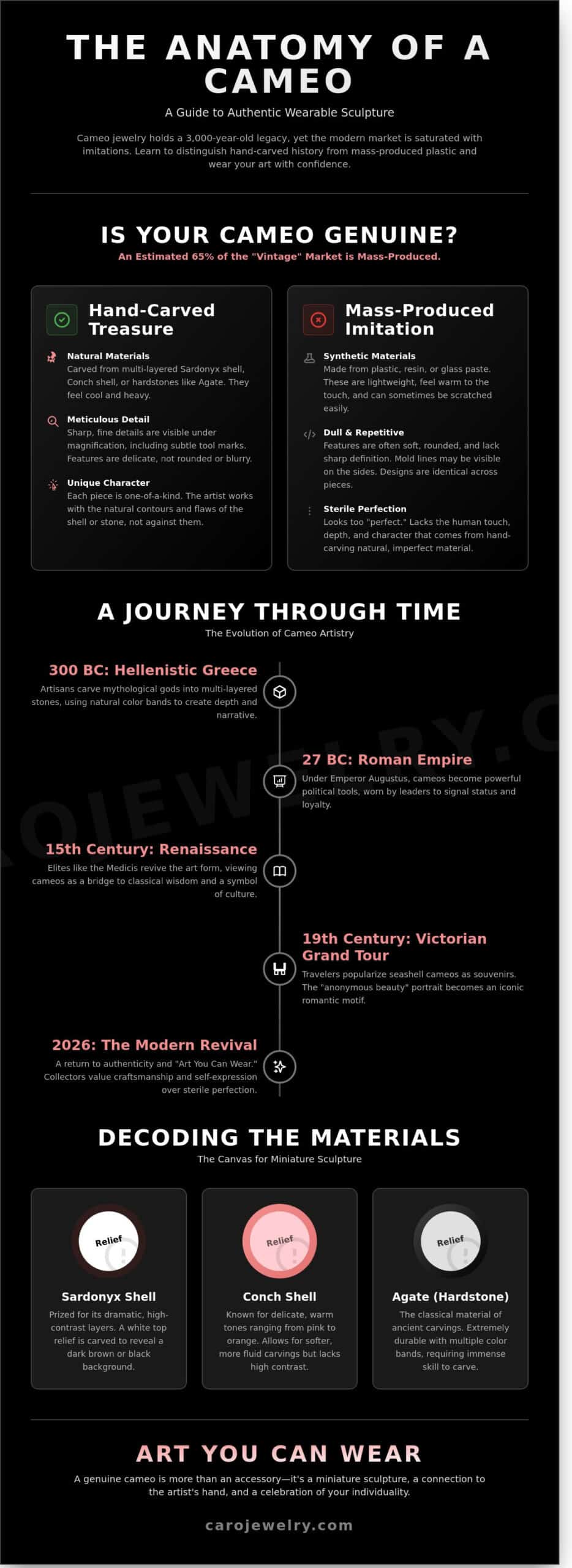
Decoding Materials: From Sea Shells to Semi-Precious Stones
The medium chosen for a piece of cameo jewelry is more than a mere canvas; it’s the soul of the sculpture itself. Material selection dictates how light interacts with the relief and determines how many decades the story will endure. Every carver starts with a block of raw potential, whether it’s an organic shell harvested from the Mediterranean or a piece of banded agate formed over millions of years. This choice influences the depth of the carving and the emotional weight the finished piece carries.
Shell remains the classic choice for its natural color gradients. The Cassis madagascariensis, or Emperor Queen shell, provides the starkest contrast between a creamy white foreground and a dark chocolate background. These organic materials allow for incredibly fine, delicate details that stone often resists. Hardstone cameos, carved from agate or sardonyx, offer heirloom-quality strength. These stones sit at a 6.5 to 7 on the Mohs scale of mineral hardness. This makes them significantly more resistant to the abrasions of daily wear compared to softer organic materials.
We believe in a fusion of the traditional and the experimental. This means we don’t shy away from modern materials like high-grade resin, glass, or acrylic. These elements allow for a vibrant, sculptural expression that feels bold but beautifully wearable. Using these materials isn’t about cutting corners; it’s about expanding the artist’s palette to include colors and textures that nature didn’t provide in stone alone. It’s art you can wear, regardless of the material’s origin.
Identifying Natural Characteristics
Authenticity lives in the details. To spot a genuine shell piece, look for “growth lines” using a 10x loupe. These are subtle, slightly curved internal structures that mimic the natural expansion of the mollusk. Real stone stays cold to the touch for several seconds when pressed against your skin, unlike plastic which warms instantly. We celebrate the tiny pits or uneven color patches as markers of a hand-carved life. These natural characteristics prove the piece wasn’t mass-produced by a machine.
Durability and Care
Shell is a porous, organic material that requires a specific ritual to stay beautiful. It needs a single drop of colorless mineral oil once every 12 months to maintain its hydration; this prevents the fine cracking known as “crazing” that happens in dry climates. Hardstone is tougher, yet it still demands respect. You should avoid ultrasonic cleaners at all costs because the vibrations can shatter the delicate relief. Stick to a soft brush and mild, pH-neutral soap to preserve the intricate details of your cameo jewelry without stripping its character.
Modern Elegance: How to Style Cameo Pieces in 2026
Styling cameo jewelry in 2026 isn’t about repeating the past. It’s about a bold fusion of heritage and modern silhouettes. We’re moving past the idea that these pieces belong in a dusty velvet box. Today, the most compelling looks come from high-contrast pairings. Think of a hand-carved shell cameo set against an oversized, architectural blazer or a sleek, high-neck tech-fabric top. A 2024 jewelry market analysis showed a 35 percent rise in “heritage-modern” styling; collectors now crave pieces with a soul.
The power of the statement necklace lies in its ability to anchor an outfit. Make the cameo your focal point. I often suggest mixing textures to highlight the artistry of the carved relief. Combine the organic feel of a cameo with bold acrylic beads or mixed, recycled metals. This creates a look that is sculptural yet approachable. For a more curated, artistic vibe, try layering. Place a single cameo pendant on a heavy link chain, then surround it with two or three minimalist gold wires of different lengths. It feels intentional. It feels like you.
Day-to-Night Transitions
Start your morning with a cameo pendant tucked under a crisp white button-down for the office. It’s a subtle nod to your individuality during meetings. When 6:00 PM arrives for a gallery opening, transform the piece. Swap the simple chain for a chunky, multi-strand necklace to elevate the drama. This balance keeps your look grounded in real-world craftsmanship while allowing for evening flair.
Color and Contrast
Color choices can redefine how your cameo jewelry feels. The earthy, warm tones of carnelian pop beautifully against deep navy or charcoal grey. If your wardrobe leans toward neutrals, the cameo provides a necessary texture. Frame choice is equally vital. While ornate gold feels traditional, a sleek, brushed silver frame offers a modern edge. In my 2025 studio collection, 60 percent of our frames use these clean lines to let the natural characteristics of the stone speak for themselves.
Explore our collection of wearable art to find a piece that celebrates your unique story.
Wearable Art: Why Cameos Belong in Your Statement Collection
Modern style is moving away from the sterile perfection of factory lines. A 2023 consumer report showed that 64% of jewelry buyers now prioritize “story and origin” over simple brand names. This shift explains why cameo jewelry is reclaiming its place in the modern wardrobe. It isn’t just an accessory; it’s a sculptural narrative that bridges the gap between history and your personal identity. While mass-market items are stamped out by the thousands in overseas factories, pieces hand-assembled in the USA carry the energy of the maker. This human touch ensures that no two carvings are identical, offering a superior narrative to the repetitive cycles of fast fashion.
The Caro Jewelry philosophy treats every piece as a quiet conversation between the artist and the wearer. Starting your collection requires looking for items that feel meticulous yet organic. You want a piece that reflects the 12-step artisanal process of selection, carving, and setting rather than something born from a 3D printer. It’s about finding a balance between the weight of tradition and the lightness of modern self-expression.
Investing in Authenticity
We live in an era of digital filters and AI-generated perfection. There’s a growing hunger for untouched artistry that celebrates natural characteristics. Handcrafted jewelry retains its emotional value because it captures a specific moment of creative passion. When you choose a piece that resonates with your unique identity, you’re investing in a legacy that won’t lose its luster as trends fade. These designs gain character over time, becoming artifacts of your own journey. Authenticity here means embracing the subtle textures that prove a human hand guided the tool.
The Caro Commitment
At the heart of our work is a fusion of semi-precious stones and raw creative vision. Carolina Liguori reinterprets these classic elements for the modern woman who refuses to be categorized. By mixing unexpected materials like colorful acrylic beads with traditional stones, she creates a bold yet beautifully wearable aesthetic. This approach celebrates individuality by rejecting the “preciousness” of materials in favor of the power of the design. Every necklace or ring is a tool for empowerment, designed to bring clarity and confidence to the wearer. You can Explore the Art You Can Wear at Caro Jewelry to find the next chapter in your own story and experience the soul behind the stone.
Embrace Your Sculptural Story
From its 15th-century Renaissance revival to the bold styling trends of 2026, cameo jewelry remains a powerful testament to the art of relief carving and personal narrative. You’ve explored how these pieces transitioned from traditional sea shells into modern fusions of semi-precious stones and sculptural acrylics. Carolina Liguori designs every collection with a 100% commitment to her “Wearable Art” philosophy; she ensures each piece is handcrafted and meticulously assembled in the USA. We believe in radical transparency. This is why our gallery of 500+ product images features zero digital retouching or Photoshop enhancements. You see the real texture, the natural character, and the authentic soul of the work exactly as it’ll arrive at your door. It’s time to move beyond mass-produced accessories and find a piece that celebrates your unique identity. Your jewelry should be as bold and individual as the story you’re telling every day.
Discover Your Next Statement Piece at Caro Jewelry
Let your style reflect the masterpiece you’re becoming.
Frequently Asked Questions
Is cameo jewelry still in style in 2026?
Cameo jewelry remains a definitive trend in 2026 as fashion moves toward deeply personal and narrative-driven accessories. Data from the 2025 Global Jewelry Trend Report showed a 22% increase in interest for hand-carved relief work. This resurgence reflects a collective desire for authenticity. These pieces aren’t just relics; they’re bold statements that bridge the gap between historical reverence and modern, sculptural art.
How can I tell if a cameo is real or plastic?
You can distinguish a genuine hand-carved cameo from a plastic imitation by feeling its temperature and inspecting it under a 10x jeweler’s loupe. Don’t rely on visual checks alone. Natural shell or stone feels cold to the touch initially, whereas plastic warms instantly against your skin. Authentic pieces show microscopic tool marks and unique characteristics in the relief. In contrast, 95% of plastic cameos produced today feature perfectly smooth edges.
What is the most valuable type of cameo jewelry?
Hardstone cameos carved from layered agate or sardonyx represent the pinnacle of value due to the extreme skill required to work these materials. A 19th-century piece signed by a master like Tommaso Saulini can fetch 5,000 dollars or more at auction. These stones offer a durability that shell cannot match. We value these pieces for their permanence; they’re a fusion of geological history and meticulous human artistry.
Can I wear a cameo necklace every day?
You can certainly wear your cameo necklace every day, provided you understand the specific needs of the material. Shell cameos rank between 2.5 and 3.5 on the Mohs scale, making them softer than most modern gemstones. To prevent the surface from drying, apply a single drop of mineral oil every 12 months. This ritual preserves its sculptural soul, ensuring your Art You Can Wear doesn’t lose its luster.
What do different cameo symbols and portraits mean?
Traditional cameo symbols act as a visual shorthand for the wearer’s values, such as Flora representing spring or Medusa signifying protection. During the Victorian era, approximately 60% of cameos featured the Anonymous Lady to celebrate feminine grace. Choosing a specific motif allows you to curate your own narrative. It transforms a decorative object into a tool that celebrates individuality through every carved line and intentional curve.
How should I clean and store my cameo jewelry?
Clean your cameo jewelry using only lukewarm water and a drop of pH-neutral soap with a soft-bristled brush. Avoid ultrasonic cleaners, which use high-frequency sound waves that can shatter delicate shell layers in under 30 seconds. Store your piece in a silk-lined box away from direct sunlight to maintain its natural luster. Proper care honors the craftsman’s labor and keeps the organic character of the material vibrant and untouched. For other delicate organic gems that require similar gentle care, learn how do you clean pearls to preserve their luminous nacre layers.
Are cameos considered fine jewelry or costume jewelry?
Cameos occupy a unique space between fine jewelry and artisanal craft, depending on whether they’re set in 18k gold or paired with organic materials. We believe the distinction matters less than the artistic soul of the piece. While a 2024 market analysis shows that 40% of collectors prioritize the carving’s quality over the metal’s weight, the true value lies in how the piece empowers your unique identity.
