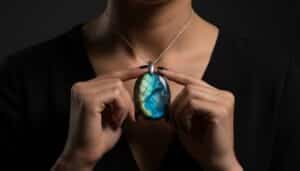
What if the true value of a gemstone isn’t found in its surface pigment, but in the light it chooses to reveal only when you move? Many collectors are drawn to the moody, shifting depths of labradorite jewelry, yet they often struggle to distinguish a genuine “flash” from a flat, low-quality imitation. It’s a common frustration to buy a piece online only to find it lacks the soul and character you expected. I agree that finding jewelry that feels like a bold expression of your identity shouldn’t feel like a gamble against synthetic materials or mass-produced flaws.
I’ll guide you through the artistic soul and scientific wonder behind these stones so you can curate pieces that mirror your own inner light. You’ll learn the precise mineral mechanics that create labradorescence and how to identify high-quality specimens with confidence. We’ll also explore the 1770 history of the stone’s discovery in Canada and provide a meticulous care routine to ensure your wearable art remains as luminous as the day you first held it.
Key Takeaways
- Uncover the scientific alchemy of labradorescence—the way light interacts with microscopic mineral layers to create a shifting spectrum of internal color.
- Explore how labradorite jewelry functions as a sculptural fusion of materials, blending semi-precious stones with organic elements to celebrate your unique identity.
- Learn the essential, gentle cleaning rituals necessary to preserve the stone’s luminous glow and protect its surface from harsh industrial cleaners.
- Discover how to find a truly authentic piece by prioritizing the stone’s “soul” and natural characteristics over the sterile perfection of mass production.
- Gain the confidence to curate pieces that mirror your inner light by understanding the importance of honest, unretouched photography in artisanal jewelry.
What is Labradorite Jewelry? The Soul of the Spectrolite
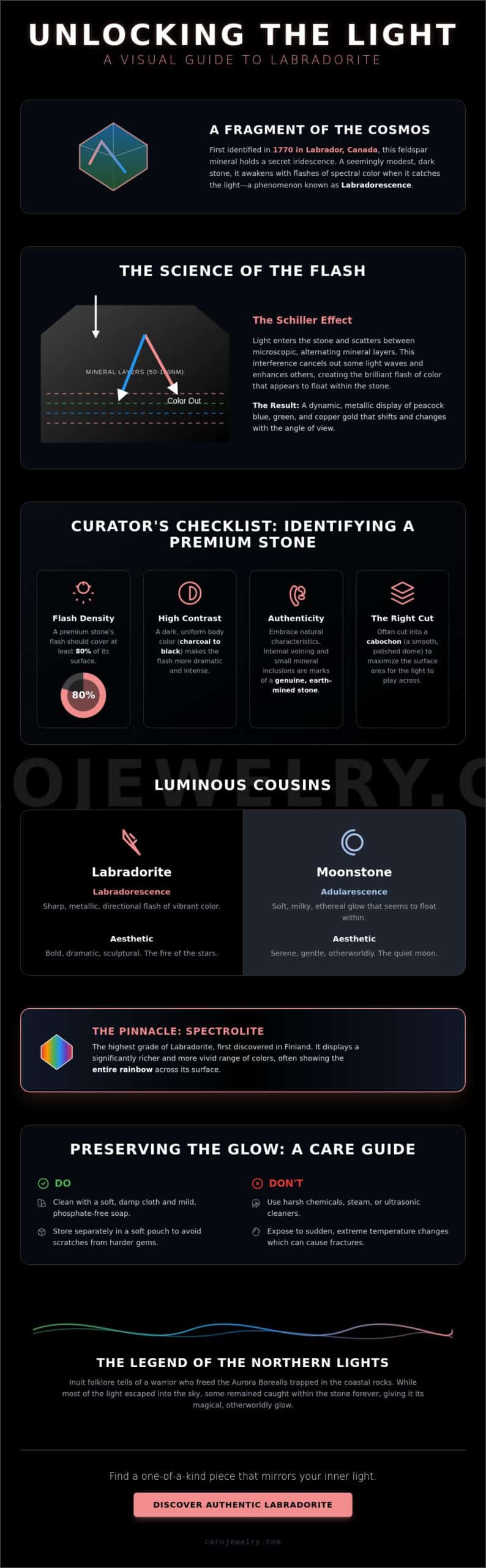
To wear labradorite jewelry is to carry a fragment of the cosmos against your skin. This mineral, a specific calcium-enriched feldspar, was first identified by Moravian missionaries in 1770 in the region of Labrador, Canada. While it appears as a modest, greyish stone at first glance, it holds a secret. When it catches the light, it reveals a metallic iridescence known as labradorescence. This optical phenomenon occurs because light reflects off microscopic layers within the stone, creating flashes of peacock blue, pale green, and copper gold.
At Caro Jewelry, we view these stones as more than mere geological specimens. They are a form of wearable art. Because the internal structure of Labradorite forms over millions of years, no two stones ever share the exact same pattern. This inherent individuality ensures that every handcrafted piece is a one-of-a-kind creation. For those seeking the pinnacle of this mineral, there is spectrolite. Originally discovered in Finland during the 1940s, spectrolite is the highest grade of this gemstone. It displays a significantly richer and more vivid range of colors than standard varieties, often showing the entire rainbow across its surface.
The Legend of the Northern Lights
The allure of this stone is deeply tied to Inuit folklore. Ancient legends tell of a warrior who encountered the Aurora Borealis trapped within the rocks along the Labrador coast. He struck the stone with his spear to free the lights, sending them spiraling back into the night sky. However, some of the light remained caught in the mineral forever. This storytelling adds a layer of spiritual depth to a labradorite jewelry piece. It transforms a necklace or ring from a simple accessory into a vessel for ancient magic and natural history. When you choose a handcrafted piece, you aren’t just buying a stone; you’re participating in a narrative that spans centuries.
Labradorite vs. Moonstone: Luminous Cousins
Labradorite and moonstone are mineralogical cousins, both belonging to the diverse feldspar family. Their differences lie in how they interact with light. Moonstone is prized for adularescence, a soft, milky glow that seems to float just beneath the surface. In contrast, labradorite demands attention with its sharp, dramatic labradorescence. While moonstone jewelry offers a serene and ethereal aesthetic, labradorite provides a bold, sculptural energy. We often celebrate both in our collections, as they represent the two sides of celestial beauty. One is the quiet moon; the other is the fire of the stars.
The Science of Labradorescence: Why the Stone ‘Flashes’
Labradorite doesn’t reveal its secrets all at once. To understand why labradorite jewelry possesses such an otherworldly glow, we have to look at its internal architecture. This mineral is a plagioclase feldspar, built from microscopic, alternating layers of different minerals like albite and anorthite. These layers are incredibly thin, often measuring between 50 and 100 nanometers. When light enters the stone, it bounces between these internal plates. This process, known as constructive interference, creates spectacular displays of color that seem to float beneath the surface.
The phenomenon is famously called the Schiller effect. It’s the reason the stone looks like a quiet, dark shadow until the light catches it at a specific angle. This transformation is what makes the material so poetic. You might see a flash of electric blue, mossy green, or even rare streaks of violet and copper. Each color corresponds to the specific thickness of those internal mineral layers; this makes every stone a unique record of geological history. It is a dance between physics and perspective.
Optical Quality: What to Look for in a Stone
When selecting a piece, focus on the flash density. This refers to how much of the stone’s surface actually ignites when moved. In premium specimens, the flash should cover at least 80 percent of the face. Contrast is equally vital. A dark, charcoal body color acts as a dramatic backdrop, making the iridescent colors pop with more intensity. Don’t be deterred by internal veining or small black inclusions. We view these as natural characteristics that add soul to the piece. These marks prove the stone is authentic and untouched by the sterile perfection of mass production.
The Role of the Cut in Unlocking Light
The cut is where the artisan’s intuition meets the stone’s physics. Most labradorite jewelry features cabochons, which are stones polished into smooth, rounded domes. This shape is chosen because the curve allows light to enter from multiple directions, increasing the chances of hitting the “flash zone.” An artisan must spend time orienting the raw stone, searching for the exact cleavage plane that holds the most light. If the cut is off by even a few degrees, the stone remains dull. Unlike mass-produced jewelry where stones are cut to fit standard molds, our process prioritizes the stone’s natural light. You can explore these light-catching designs in our collection of handcrafted wearable art.
Labradorite as Wearable Art: Designing with Light
Designing with labradorite feels like capturing a storm in a bottle. Each stone presents a unique landscape of light, demanding a design approach that honors its individual character. At Caro Jewelry, we view labradorite jewelry as a collaborative process between the artist and the earth’s natural geometry. Because no two stones share the same internal fire, every piece becomes a singular expression of identity. We don’t believe in mass-produced perfection; we believe in the soul of the material.
This stone acts as a sophisticated neutral. Its base of charcoal and deep grey provides a grounded foundation, while the spectral flashes of peacock blue or copper gold allow it to harmonize with any color palette. It doesn’t just sit against fabric; it interacts with the wearer’s surroundings. Whether paired with a crisp white linen shirt or a dark evening gown, the stone adapts, shifting its mood as the light changes. This versatility makes it an essential tool for self-expression, bridging the gap between everyday wear and high-concept artistry.
The Statement Piece: Labradorite in Bold Designs
Large, raw-cut slabs of labradorite serve as the perfect anchor for sculptural necklaces. These pieces aren’t meant to be subtle. They are intended for those who treat their wardrobe as a gallery. When you explore the art of the statement necklace, you’ll find that the weight and presence of a significant stone create an immediate emotional shift. It offers a sense of protection and confidence. As you move, the stone responds, revealing hidden depths that mirror your own internal layers. This is the essence of Art You Can Wear, where the jewelry becomes a part of your kinetic energy.
Mixing Textures: Labradorite and Earthy Elements
We believe in the power of fusion. By pairing the metallic, ethereal flash of labradorite with the matte, grounded textures of organic materials, we highlight the stone’s inherent beauty. Mixing these mediums creates a dialogue between the celestial and the terrestrial. Our meticulous selection process ensures that every bead and component serves the overall narrative of the piece.
- Pairing labradorite with the earthy, stabilized tones of jasper jewelry provides a warm, tactile contrast.
- Combining it with the royal, flecked depth of lapis lazuli jewelry emphasizes the cool, blue undertones of the labradorescence.
- Integrating unexpected elements like reclaimed wood or vintage acrylic beads elevates labradorite jewelry into a modern, mixed-media masterpiece.
We celebrate the natural characteristics of every material, refusing to hide the character marks that give a piece its soul. Our commitment to 100 percent untouched photography ensures the piece you see is the honest, vibrant reality you’ll wear. This transparency celebrates individuality, inviting you to own a piece of jewelry that is as authentic and unretouched as you are.
Caring for Your Labradorite Jewelry: Preserving the Glow
Labradorite is a stone of profound character, yet its physical structure requires a gentle hand to maintain its ethereal brilliance. On the Mohs scale of mineral hardness, this feldspar mineral ranks between 6 and 6.5. To put this in perspective, common household dust often contains particles of quartz, which sits at a 7. This means your labradorite jewelry is durable enough for daily expression but susceptible to micro-scratches if handled carelessly. It’s a sculptural piece of the earth that deserves a dedicated space in your collection, away from the sharp edges of diamonds or sapphires.
Cleaning your piece is a ritual of restoration rather than a chore. Avoid the harsh vibrations of ultrasonic cleaners, as these machines can trigger fractures along the stone’s natural cleavage planes. Instead, follow these meticulous steps:
- Submerge the piece in lukewarm water mixed with a drop of mild, pH-neutral dish soap.
- Use a soft-bristled brush or a microfiber cloth to gently lift away debris.
- Rinse thoroughly with clean water to ensure no soapy film remains to cloud the labradorescence.
- Pat dry with a lint-free cloth and allow it to air dry completely before storage.
Chemical exposure is the silent enemy of natural stones. Perfumes, hairsprays, and lotions contain alcohol and acidic compounds that can etch the surface over time. Apply these products and let them dry fully before donning your jewelry. Similarly, while the stone’s color is a result of light refraction rather than pigment, prolonged exposure to intense, direct sunlight can occasionally cause thermal shock within the mineral layers. Treat your jewelry as the wearable art it is, protecting it from extreme environments.
Cleaning Your Artisan Settings
Many of our designs celebrate the fusion of diverse materials, pairing the stone with meticulous metalwork or organic accents. If your piece features mixed media, you must tailor your approach. For the metallic elements, consult our guide on how to clean silver jewelry to maintain that polished contrast. If your design incorporates delicate spheres of calcium carbonate, our specialized advice on cleaning pearls will help you preserve their soft luster without compromising the labradorite’s integrity.
Restoring the Flash
A common myth suggests that the blue and gold “flash” of labradorite can fade or disappear. Because this glow is a physical property of the stone’s internal structure, it’s permanent. If your stone appears dull, it’s typically because skin oils have created a microscopic barrier on the surface. A simple wipe with a damp cloth usually reveals the hidden fire instantly. For pieces that have seen years of adventurous wear, a professional jeweler can perform a light repolish to remove surface abrasions, ensuring your labradorite jewelry continues to celebrate your individuality with every movement.
Discover the perfect addition to your collection by exploring our latest handcrafted labradorite designs today.
Finding Your One-of-a-Kind Labradorite Piece
Selecting a piece of jewelry is rarely just a transaction. It’s a discovery of something that resonates with your internal rhythm. When you browse for labradorite jewelry, look past the price tag to find the soul of the stone. Each piece should feel like a conversation between the earth and the artist. Mass-produced items often lose this connection, resulting in sterile designs that lack emotional weight. We believe the true value lies in the story the stone tells when it catches the light.
Handcrafted artistry offers a level of individuality that machines cannot replicate. We focus on the sculptural quality of every setting, ensuring the metal honors the stone’s natural characteristics. This approach celebrates imperfections as markers of authenticity. You aren’t just buying an accessory; you’re acquiring “Art You Can Wear.” It’s about finding a piece that feels as bold and unique as your own journey.
- Look for depth in the labradorescence, not just surface shine.
- Prioritize “untouched” photography to avoid the disappointment of digitally enhanced colors.
- Choose artists who value ethical sourcing and transparent crafting processes.
Custom Commissions: Creating Your Personal Totem
A custom commission is the ultimate expression of personal identity. The process begins with the stone itself. You’ll choose a specific labradorite from our curated collection, looking for the particular flash of blue, gold, or green that speaks to you. This collaborative journey between the collector and the artist ensures the final piece functions as a personal totem. It’s a meticulous fusion of your vision and our creative passion. We build the design around the stone’s unique shape, creating a wearable sculpture that belongs only to you. This ensures your labradorite jewelry is a true one-of-a-kind masterpiece.
The Caro Commitment to Authenticity
Our brand stands on a foundation of uncompromising honesty. We use ethically sourced materials to ensure your jewelry carries a positive legacy from the mine to your wardrobe. We maintain a strict “no Photoshop” rule for all our imagery. This means the fire you see in our photos is the true character of the stone, not a digital fabrication. We don’t hide natural flaws; we highlight them as evidence of a stone’s organic origin. This transparency builds a bridge of trust between our studio and your collection. Discover your next handcrafted labradorite piece and find a stone that reflects your bold, unique spirit.
Embrace Your Own Luminous Narrative
Labradorite is more than a simple accessory; it’s a living dialogue between light and mineral. You’ve seen how the science of labradorescence creates those ethereal flashes, turning a dark stone into a spectrum of hidden color. Every piece in our studio is 100% handcrafted in the USA, ensuring that the soul of the artisan remains intact within the sculptural metal. We believe in radical authenticity, which is why our imagery features 0% digital retouching. This commitment to honesty means the stone you receive possesses the same raw, unedited character you fell in love with online.
Choosing the right labradorite jewelry is an act of self-discovery. It’s about finding a piece that mirrors your complexity and celebrates your individuality. Our “Art You Can Wear” philosophy ensures that your jewelry isn’t just a decorative object, but a bold expression of your unique identity and creative spirit. We invite you to find the stone that speaks to your journey and let its inner light amplify your own.
Explore the Handcrafted Labradorite Collection at Caro Jewelry
Wear your light with confidence and let your story shine through every movement.
Frequently Asked Questions
What is the meaning of labradorite in jewelry?
Labradorite serves as a stone of transformation and spiritual awakening, acting as a mirror for the wearer’s inner light. Historically discovered in 1770 in Labrador, Canada, this mineral belongs to the feldspar family and is prized for its labradorescence. In our studio, we treat each stone as a sculptural element that celebrates individuality. It represents the bridge between the physical world and the ethereal, offering a sense of clarity to those who choose art you can wear.
Is labradorite jewelry suitable for everyday wear?
Labradorite is durable enough for daily wear but requires mindful handling because it ranks between 6 and 6.5 on the Mohs scale of mineral hardness. This rating means it’s softer than quartz or sapphire; it can sustain scratches if it hits a hard surface. To protect your labradorite jewelry, we suggest removing rings during heavy manual work. Choosing a bezel setting provides a protective metal border that guards the stone’s edges against impact.
How can you tell if labradorite is real or fake?
Authentic labradorite displays a unique optical phenomenon where colors shift as you rotate the stone, a trait that glass or plastic imitations cannot perfectly replicate. Natural stones often feature internal inclusions or small black lines called schiller that appear in 95 percent of genuine specimens. If the color looks painted on or remains static from every direction, it’s likely a counterfeit. Our commitment to authenticity means we use only natural, unretouched stones that showcase their true character.
Does labradorite jewelry lose its color over time?
Natural labradorite does not fade or lose its color because the flash is a result of light reflecting off internal mineral layers rather than a chemical pigment. However, a buildup of skin oils or soaps can create a film that dims the stone’s brilliance. Cleaning your labradorite jewelry with a soft, dry cloth every 30 days restores its original luminosity. This ensures the sculptural beauty of the piece remains as vivid as the day it was handcrafted.
What colors of clothing look best with labradorite jewelry?
Deep charcoal, navy blue, and forest green provide a sophisticated backdrop that pulls out the cool blue and green flashes within the stone. For a bolder look, pairing the jewelry with burnt orange or mustard yellow creates a high-contrast aesthetic that highlights the gold and copper tones often found in the labradorescence. We believe jewelry is a fusion of art and identity. These color combinations allow the stone to act as a focal point for your unique style.
Can labradorite get wet?
Occasional contact with water won’t harm the stone, but you should avoid submerging it in liquids for extended periods or using ultrasonic cleaners. Chemicals found in tap water, such as chlorine or fluoride, can damage the stone’s surface over time. If your piece gets wet, dry it immediately with a soft cloth to prevent mineral deposits from forming. This meticulous care preserves the integrity of the natural characteristics that make your wearable art special.
What is the difference between labradorite and spectrolite?
Spectrolite is a rare, high-grade variety of labradorite found exclusively in Finland, first discovered during trench excavations in 1940. While standard labradorite usually shows blue or green flashes, spectrolite displays a full spectrum of colors including red, orange, and purple. It possesses a darker, more opaque base color that makes the iridescent layers appear more intense. Both stones celebrate individuality through their distinct, natural patterns that no machine can replicate.
Why does my labradorite only flash at certain angles?
This effect occurs because the light must hit the internal lamellar structures at a specific angle, typically between 10 and 30 degrees, to create the interference pattern known as labradorescence. It’s a physical property of the stone’s lattice structure rather than a flaw. This directional glow adds a layer of mystery and movement to each piece. It invites a closer look, turning the jewelry into a personal, interactive experience between the wearer and the light.